Bolted vs Welded Space Frames: Advantages for Architecture and Construction
Published on Category: Space frames

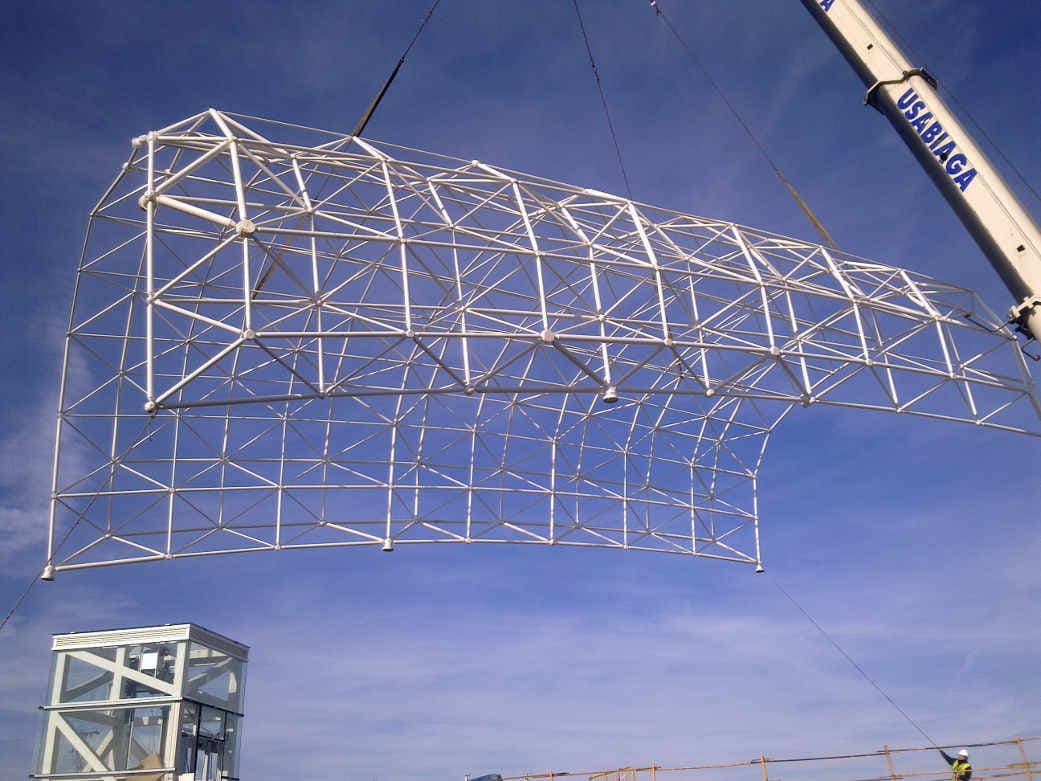
When you specify a space frame, one of the earliest decisions is whether the members will be bolted or welded on site. Both technologies produce strong, durable structures — but they differ sharply in fabrication, transport, installation time, on-site safety and total cost. The choice has a direct impact on schedule, logistics and the carbon footprint of your project.
A space frame is a three-dimensional truss made of hundreds or thousands of individual struts and nodes. The way those elements are joined determines how the kit ships, how long it takes to build, how easy it is to repair or extend, and what skills are needed on site. Architects and engineers therefore treat the connection type as a primary design parameter, not an afterthought.
In a welded space frame, the tubes are cut to length and welded directly to the node — historically at the site, although modern welded systems are increasingly prefabricated in the workshop.
Advantages
Drawbacks
In a bolted space frame, prefabricated tubes terminate in threaded ends or end-fittings that are screwed into spherical or cylindrical nodes. The entire structure is assembled with hand tools and a torque wrench.
Advantages
Drawbacks
Welded space frames remain the default for very heavy industrial loads and for highly bespoke geometries where every node is unique. Bolted space frames are usually the better answer for architectural projects — long-span roofs, atriums, canopies, free-form facades — where speed of installation, site safety, transportability and a clean architectural finish matter most.
Mettalik uses a fully integrated CAD/CAM workflow to design, fabricate and assemble bolted space frames with no welding required on site. Bars and nodes are produced to tight tolerances in our workshop, packed into containers for international delivery and erected with hand tools — keeping projects safe, fast and predictable wherever they are built.
Are bolted space frames as strong as welded ones?
For most architectural applications, yes. Properly tightened bolted connections develop the full strength of the tube, and the inherent redundancy of a space frame means no single connection is critical to overall stability.
Can bolted space frames be reused?
Yes. Because they are assembled without welding or grouting, they can be disassembled, transported and re-erected — which is why bolted systems are popular for temporary venues and relocatable buildings.
Which system is more sustainable?
Bolted systems usually win on logistics: smaller shipping volume, less site waste and full reversibility at end of life. Welded systems can still be the right choice when very compact joints or unusual geometries are required.